Pressing play loads the video from YouTube. Privacy
Standardising paediatric oral fluid challenges
- Dr Rosie RootsPaediatrician at Evelina London Children’s Hospital

Key points
- A survey across the REACH network confirmed that sites use different indications, protocols and pass criteria for paediatric oral fluid challenges.
- Most clinicians were not following their own guideline or the NICE gastroenteritis guideline, or were only doing so partially.
- A systematic review is under way to find a best practice recommendation to share across the London network and reduce the need for admission.
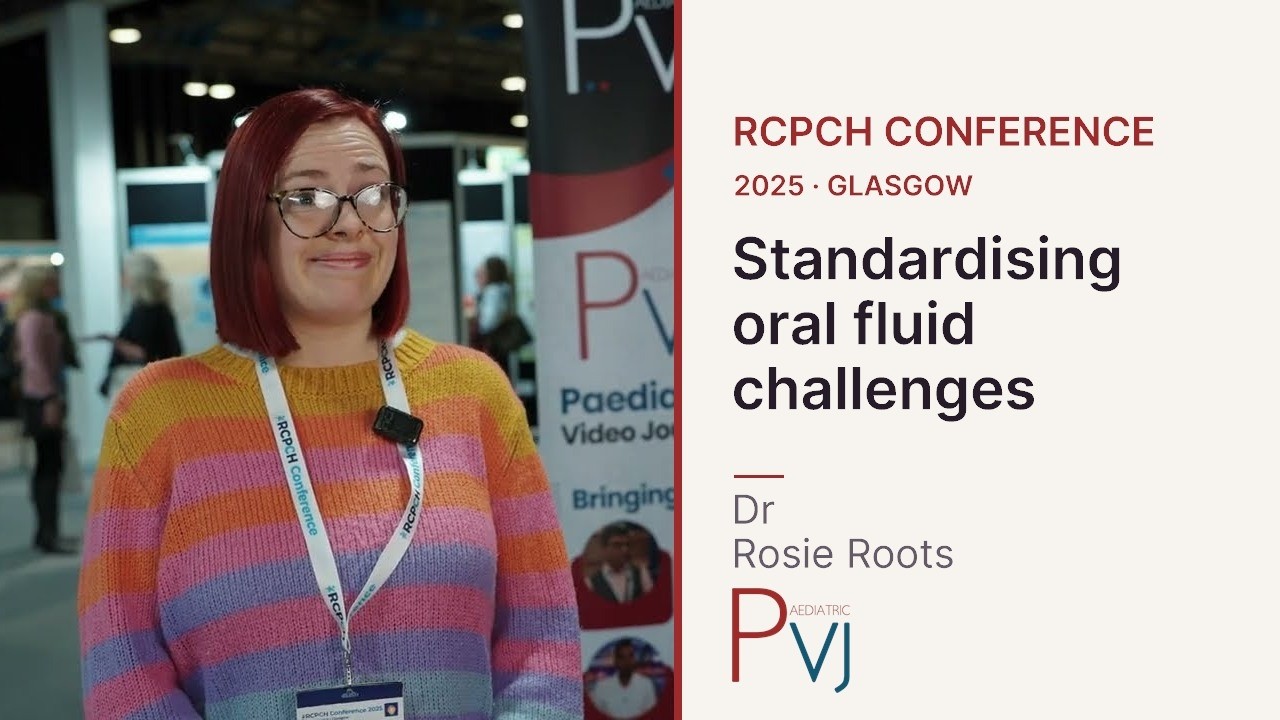
Dr Rosie Roots, a paediatrician at Evelina London Children’s Hospital, provides insights into a collaborative project examining the process for paediatric oral fluid challenges across the London region, in partnership with the REACH research network. The discussion highlights the significant variation in how these challenges are conducted—including differences in clinical indications, protocols, and criteria for success—and how this impacts patient outcomes. Dr Roots details the findings from a multi-site survey, which confirmed widespread inconsistency in practice and limited adherence to local and national guidelines. She emphasises the importance of standardising oral fluid challenge protocols to improve the success rate and reduce unnecessary hospital admissions. The next phase of the project involves a systematic review to identify best practice recommendations for dissemination across the region. This interview took place at the RCPCH conference 2025 in Glasgow, Scotland.
Read the transcript
Automatic transcript, lightly edited for readability. It may contain errors, so check it against the video before quoting.
We undertook a project looking at the process for paediatric oral fluid challenges across the London region in collaboration with the REACH research network. Essentially, anecdotally, we've all known for a long time that everyone does a paediatric oral fluid challenge differently. And we were wondering, does that impact the success of the challenge? If we were all doing it the same way, would we get better results?
I think the first point in this process is to actually prove what we think anecdotally, is everyone doing something different. So across the REACH network we disseminated a survey that looked at how and why people were doing paediatric oral fluid challenges, which meant the inclusion, why they were being done, the indications, then the protocol for how they were being done and then the criteria for passing the challenge. The REACH leads at each site filled out the questionnaire. We also asked each site to submit their own guideline if they had a guideline.
When we looked at the responses, it confirmed what we thought. Basically, everyone is doing a paediatric oral fluid challenge for different reasons and using a different process. The main clinical indications were diarrhoea and vomiting, fever, and generally poor oral intake. There was at least six different fluids being used for the challenge, with the most popular being oral rehydration solution, and antiemetic was about 50/50 whether it was being used or not. And pass criteria were really, really diverse and poorly defined. That included clinical judgment, incidence of vomiting and a particular amount of fluid drunk, and the amount of that fluid varied.
And then we evaluated clinician responses versus their own guideline and also against the NICE guideline for gastroenteritis. And we found actually most of the time the clinicians at site weren't following their own guideline, or at least only doing so partially, and the same thing, they weren't following the NICE guideline or only doing so partially. Very few sites were fully adherent to either their own guideline or the NICE guideline.
So we've essentially confirmed what we thought. Everyone is doing paediatric oral fluid challenges differently. So this leads us to our next step in this research, which is how should we be doing them? What does research recommend as best practice? And currently the REACH network are undertaking a systematic review into the research around paediatric oral fluid challenges to see if there's a best practice recommendation that we can then disseminate across the London network. We can then evaluate whether this improves the success of paediatric oral fluid challenges and reduces the need for admission to hospital for intravenous fluids.
Topics
Share
Cite this video
Dr Rosie Roots. “Standardising paediatric oral fluid challenges.” The Paediatric Video Journal, 22 June 2025. https://paediatricvj.com/videos/standardising-paediatric-oral-fluid-challenges-roots/
This interview is educational content intended for healthcare professionals and is not medical advice. Views expressed are those of the speaker. © The Paediatric Video Journal. All rights reserved.