Pressing play loads the video from YouTube. Privacy
Improving high-flow weaning in district general hospitals
- Diana IskanderPaediatric Consultant at William Harvey Hospital

Key points
- A retrospective audit of 42 children in two district general hospitals found that many did not follow the weaning strategy in the high-flow guideline.
- High flow was most often started for respiratory distress rather than hypoxia, so the guideline's FiO2 banding was often hard to apply.
- Awareness has been raised, work of breathing added to the local guideline, and the findings shared with the guideline writers.
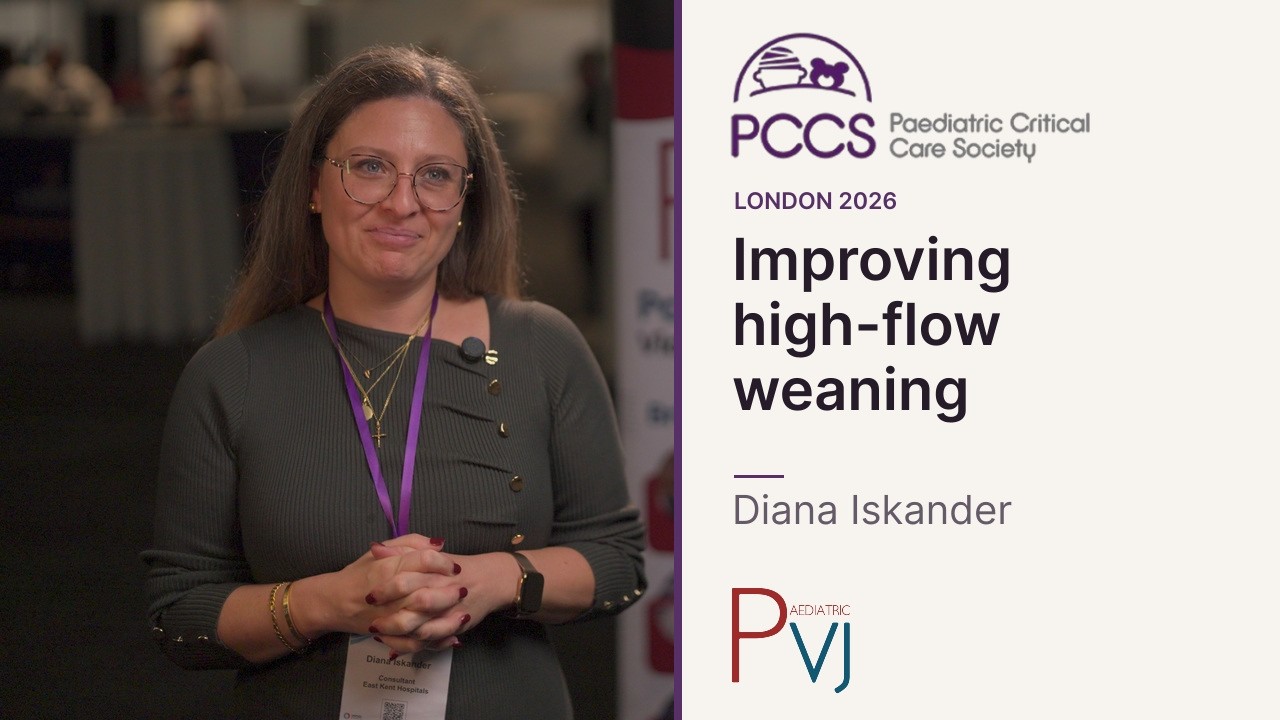
Diana Iskander, Paediatric Consultant at William Harvey Hospital, discusses a retrospective audit of high-flow weaning in two district general hospitals. She describes reviewing adherence to a regional guideline and examining why practice did not always follow its oxygen-based weaning approach. The interview explores the importance of considering respiratory distress and work of breathing alongside oxygen requirements. Diana reflects on the limitations of the audit, steps taken to improve clinicians’ awareness and changes to local guidance, as well as sharing the findings to inform future guideline development.
This interview took place at the PCCS Annual Scientific Meeting 2026 in London.
Read the transcript
Automatic transcript, lightly edited for readability. It may contain errors, so check it against the video before quoting.
It's a retrospective audit of children aged 0 to 16 in two district general hospitals, and we were looking at the adherence to the high flow weaning guideline that we use, which is the STPM guideline. The background to this is that we have found that high flow is being used increasingly for children with respiratory distress, but we don't have enough evidence in relation to the optimal weaning. So we potentially could be putting children on therapy for longer than they really need to. I've also noted that a lot of children remain on high flow until their FiO2 reaches 21%, which is basically air. So the aim of this project was to assess the adherence to the STPM weaning aspect of the high flow guideline.
The study was an audit. So it was a retrospective audit of 42 children aged 0 to 16 across two district general hospitals. The data was pulled out from our paediatric critical care dashboard and it was pulled into an Excel spreadsheet and that's how it was analysed.
In terms of the results, mainly as expected, the median age was about 7 months of age with the most common diagnosis being bronchiolitis. In terms of the adherence to the protocol, there was a large proportion of children who did not follow the weaning strategy that was outlined in the guideline. A few reasons for that is that we found that the most common indication for the high flow to be initiated was respiratory distress and not particularly hypoxia, and the guideline weaning protocol really is focused around FiO2 banding. So those children might have near normal oxygenation but they have a respiratory distress. So hence it was really difficult to follow that guideline from that aspect. Also the majority of patients reached a maximum of high flow that is less than FiO2 is less than 40%. So again the FiO2 banding was not really applicable to them. And finally a large proportion, about two-thirds of the patients, remained on FiO2 of 21% before high flow was stopped.
So the conclusion is that we didn't have good adherence to the guideline, but also it was a retrospective small study and we did not take into account the work of breathing, which could have informed the clinician's decision-making and could have explained why the guideline was not adhered to.
So in terms of action plans, we've moved actually by increasing the clinicians' awareness of the guideline. We've also incorporated work of breathing along with the FiO2 banding and oxygenation to the guideline, and I've also shared the findings with STPM, which is the writers of the guideline, and I hope that they will incorporate in future updates. Thank you.
Topics
Share
Cite this video
Diana Iskander. “Improving high-flow weaning in district general hospitals.” The Paediatric Video Journal, 7 November 2026. https://paediatricvj.com/videos/improving-high-flow-weaning-in-district-general-hospitals-iskander/
This interview is educational content intended for healthcare professionals and is not medical advice. Views expressed are those of the speaker. © The Paediatric Video Journal. All rights reserved.