Pressing play loads the video from YouTube. Privacy
How paediatric ARDS research differs from adult evidence
- Dr Becky MittingConsultant in Paediatric Intensive Care at St Mary’s Hospital

Key points
- Adult ARDS evidence, including proning and ECMO trials, does not simply apply to children, whose compliance, airways, FRC and lungs differ.
- Paediatric trials such as the PROSPECT trial have been negative, and there is nothing like the evidence base available in adults.
- Next steps are probably precision medicine, enriching trial populations and tailoring treatments to the phenotypes or endotypes being managed.
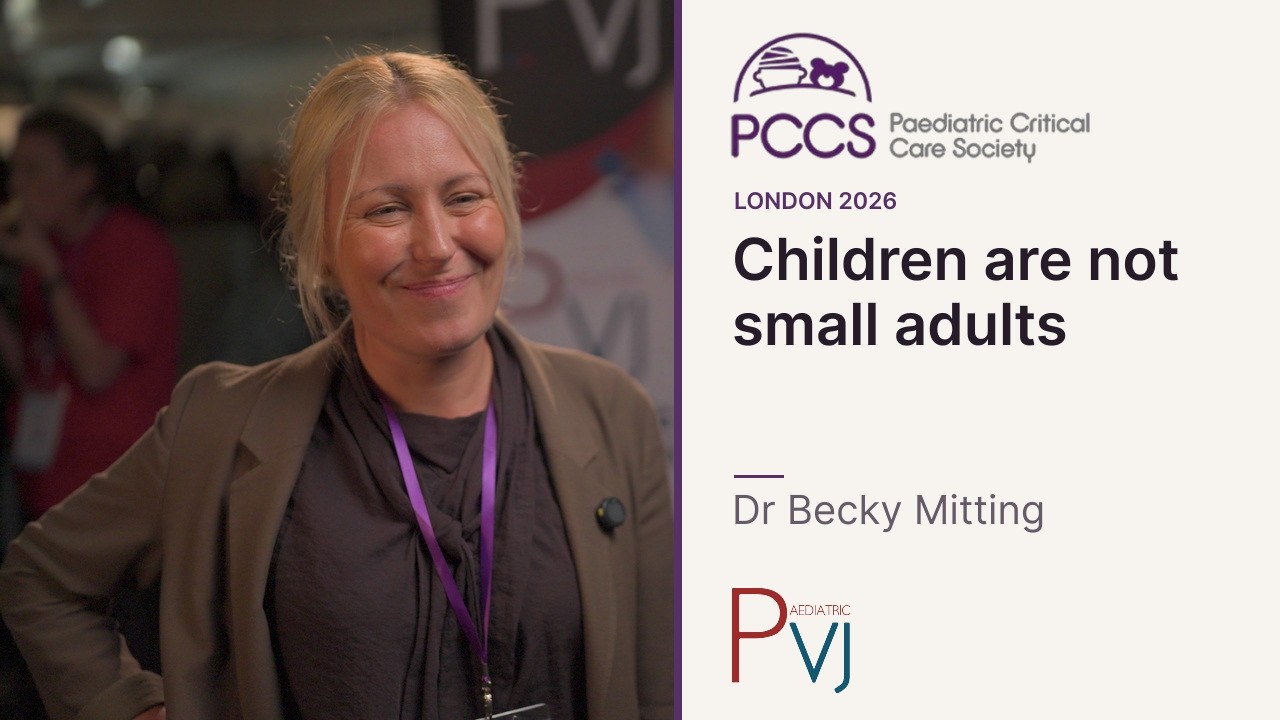
Dr Becky Mitting, Consultant in Paediatric Intensive Care at St Mary’s Hospital, reflects on discussions comparing adult and paediatric acute respiratory distress syndrome research. She explores why findings from adult studies cannot automatically be applied to children, considering differences in lung physiology and the available trial evidence. The interview highlights questions raised by a joint conference session and the potential role of more targeted research. Dr Mitting discusses the opportunities offered by precision medicine while emphasising the need to understand paediatric illness on its own terms when developing future studies.
This interview took place at the PCCS Annual Scientific Meeting 2026 in London.
Read the transcript
Automatic transcript, lightly edited for readability. It may contain errors, so check it against the video before quoting.
I'm here to talk about my session this morning. We did a breakfast session, and I was really honoured to be joined by Luigi Camporota, who's a really prominent researcher in the field of ARDS, especially APRV and ECMO, in adult intensive care. And we did a joint session where we looked at the adult evidence for ARDS, and we know there's tons of evidence in ARDS in adults. We know that there's evidence for proning. We know that they actually have trials in ECMO, which we are lacking.
So we reviewed the adult literature and then compared why the adult literature really doesn't apply to children, and what evidence we do have in children. So of course we know children have really variable compliance, narrow airways, lower FRCs, their lungs are different from adults, and so what constitutes injurious ventilation and causes lung injury might be quite different for our patients. We talked about adults really looking at mechanical power to measure lung injury now, whereas we're maybe thinking actually respiratory rate may not be so relevant for children, because physiologically they have a high respiratory rate, and some papers suggest that outcomes are more closely aligned with mechanical energy.
We had a look at the paediatric trials that we do have. We know that there's been one negative trial with 50 children in each arm, looking at proning, published in 2005, and then of course we've had the PROSPECT trial. So despite the fact that there's a very large trial in adult patients showing significant mortality for proning, we've seen the results of the PROSPECT trial, a 4x4 trial looking at HFOV, conventional mechanical ventilation, proning, and not finding in children, which again was a negative trial and didn't show any difference in primary outcome.
But we spent quite a bit of time discussing why children's lungs might be different from adults and also why children's trials and adult trials are different. Luigi was presenting a meta-analysis involving 4,600 adults with ARDS and 18 clinical trials. Well, of course, we just don't have that kind of evidence in children. So we've made a start. We know that the next steps are probably precision medicine. We need to enrich our population. PARDS is a really heterogeneous syndrome with lots of different aetiologies possible.
So we look at new trials that will enrich our population, see if we can get the right children and try to tailor things like biologics, steroids, viruses and things like high PEEP and low PEEP to the phenotypes or endotypes that we're actually managing.
Topics
Share
Cite this video
Dr Becky Mitting. “How paediatric ARDS research differs from adult evidence.” The Paediatric Video Journal, 7 November 2026. https://paediatricvj.com/videos/how-paediatric-ards-research-differs-from-adult-evidence-mitting/
This interview is educational content intended for healthcare professionals and is not medical advice. Views expressed are those of the speaker. © The Paediatric Video Journal. All rights reserved.