Pressing play loads the video from YouTube. Privacy
What makes paediatric critical care trials succeed?
- Professor Kathy RowanFounder and Scientific Advisor at ICNARC
Key points
- The UK paediatric critical care community has built an evidence base of randomised clinical trials to identify the best treatments for critically ill children.
- Collegiality, collaboration and links with methodologists for data methods and modelling underpin this work.
- Complete data collection and a high degree of adherence to the interventions make the trials eligible for high-impact peer-reviewed publication.
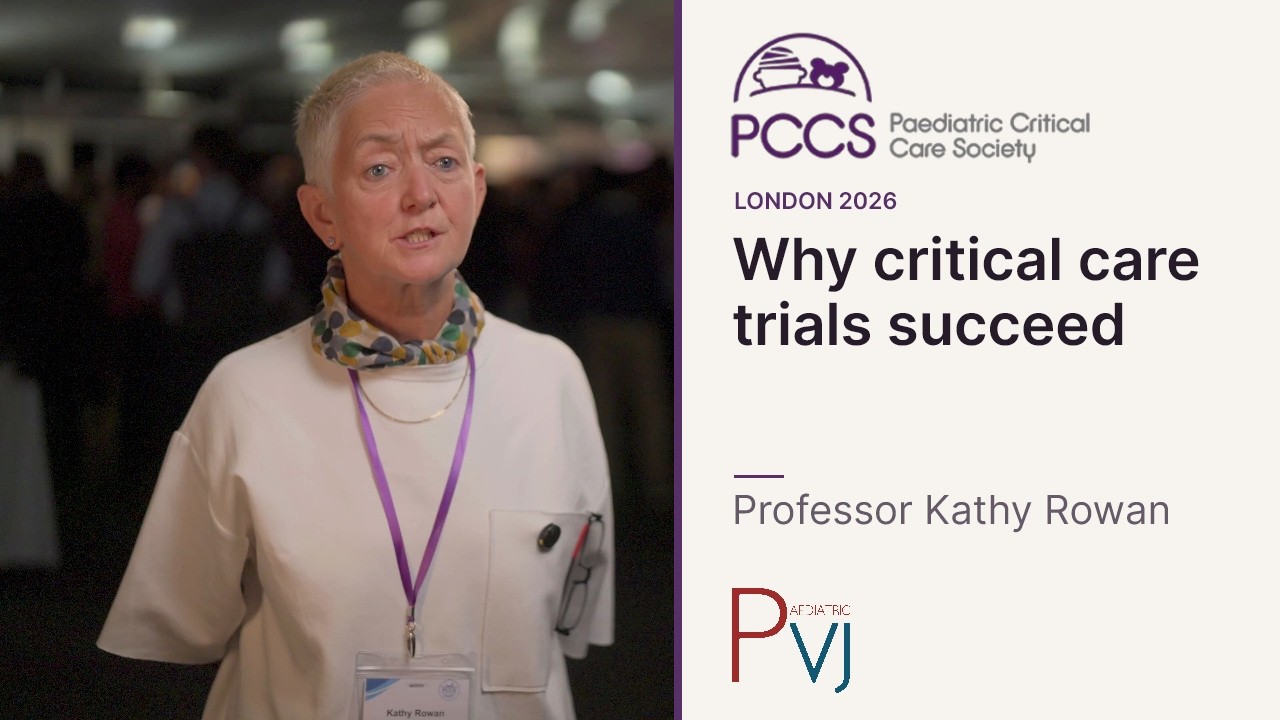
Professor Kathy Rowan, Founder and Scientific Advisor at ICNARC, provides insights into the achievements of the UK paediatric critical care community in delivering randomised clinical trials. She reflects on the collaborative culture behind this work and the contribution of expertise in methodology, data and analysis. The interview highlights the importance of high-quality trial delivery, including complete data collection and adherence to the interventions being evaluated. Professor Rowan explains how these shared efforts have helped produce a substantial evidence base and enabled findings from paediatric critical care research to reach an international audience through major scientific publications.
This interview took place at the PCCS Annual Scientific Meeting 2026 in London.
Read the transcript
Automatic transcript, lightly edited for readability. It may contain errors, so check it against the video before quoting.
In my plenary presentation, I was setting out the amazing achievements of the paediatric critical care community in delivering an evidence base in the form of randomised clinical trials to identify the best treatments for critically ill children. They've had a phenomenal output, and I set out the very many factors that I thought were responsible for that.
Those factors were the general collegiality and collaborative spirit of the paediatric critical care community, and the investment they've made in linking up with methodologists for data methods and modelling to underpin the important work they do. I think the community itself delivering the trials on the ground. They've all been published in very high ranked peer-reviewed scientific publications, but that's because they're so well delivered on the ground. And delivery often is the completeness of the information that's collected in the trial, but also the adherence to the intervention.
And it's really important that when someone's randomised to the intervention being evaluated that that intervention is actually delivered as specified. And it's phenomenal that there's such a high degree of adherence in paediatric critical care trials that makes them then eligible, once analysed and written up, to be published in these, as I say, very high impact peer-reviewed scientific publications. Which means that the information that the paediatric critical care society is generating in the UK gets celebrated and communicated worldwide.
Topics
Share
Cite this video
Professor Kathy Rowan. “What makes paediatric critical care trials succeed?.” The Paediatric Video Journal, 7 November 2026. https://paediatricvj.com/videos/what-makes-paediatric-critical-care-trials-succeed-rowan/
This interview is educational content intended for healthcare professionals and is not medical advice. Views expressed are those of the speaker. © The Paediatric Video Journal. All rights reserved.